

Key Takeaways
- If your return is truly simple (one W-2, standard deduction, no investments or side income), tax software may be sufficient.
- If you have self-employment income, rentals, investments, multi-state issues, or major life changes, filing with a professional is worth it.
- Software handles compliance. A professional provides strategy, error prevention, and representation if the IRS contacts you.
- The real question isn’t just cost. It’s complexity, time, and how much risk you’re comfortable managing on your own.
The choice every taxpayer faces this time each year: File your taxes with low-cost software or with a tax pro?
And let’s just get it out in the open… You may think I’m biased on this subject.
But truly, my goal for you is a stress-free tax season that supports your long-term financial stability.
Your tax situation is unique, and there isn’t a black-and-white answer here.
Let’s walk through the pros and cons so you can make the best (and most informed) decision about how you file.
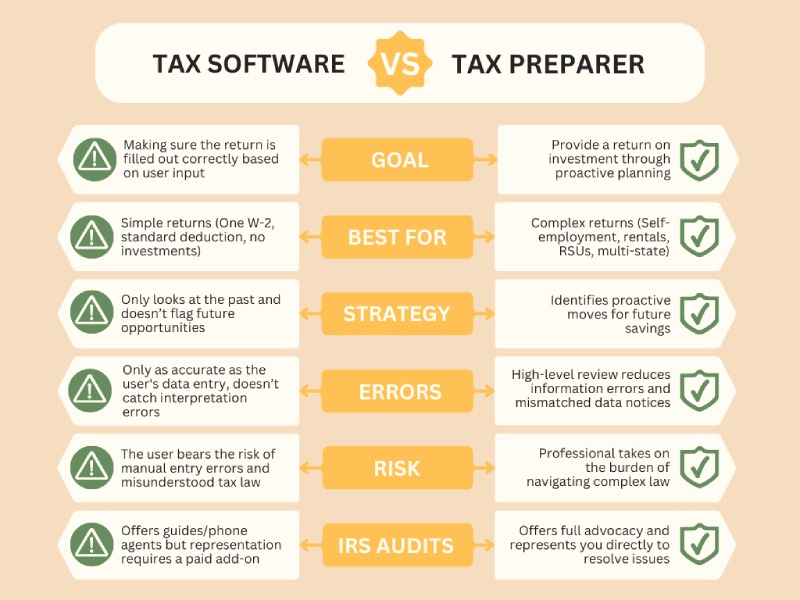
Should you use software like TurboTax or H&R Block to file your taxes?
You can use DIY software like TurboTax or go to H&R Block if you have a very simple tax situation, such as a single W-2, no investments or rental properties, and you plan to take the standard deduction. It can be a cost-effective choice if you’re on a tight budget and you’re confident in entering your own data.
These tax filing programs appeal to so many because they’re “free” (or close to it).
And software might make sense for you if you want to minimize upfront cost, you’re fully confident entering your own data and claiming your own deductions and credits, and you have a very simple return.
And by a very simple, I mean:
- One McMinnville employer and one W-2
- No self-employment income
- No rental property
- No K-1s
- No stock options, crypto transactions, or complex investments
- Taking the standard deduction
If that’s your situation, software can likely get you to a compliant return.
But compliant does not mean optimized.
Software is essentially a very sophisticated questionnaire. It will calculate correctly based on what you enter.
It does not step back and ask whether your overall tax picture could be structured differently next year. It doesn’t look at your retirement contributions and suggest how to shift income across tax brackets. It doesn’t flag long-term planning opportunities.
It checks boxes. And it’s only as accurate as the information you provide.
One of the leading causes of IRS notices is mismatched data. Like a typo in a Social Security number, a misread 1099-NEC, or a K-1 that wasn’t entered correctly.
Software won’t catch these issues if your original interpretation was wrong.
When should you hire an accountant for taxes?
DIY filing starts to break down when complexity enters the picture.
When should you hire an accountant for taxes? I recommend you do so if…
- You started a side hustle or became self-employed
- You bought or sold a home
- You have rental property
- You received stock options or RSUs
- You traded crypto
- You lived or worked in more than one state
- You received trust or estate distributions
- You have multiple 1099s, K-1s, or investment accounts
Self-employment alone changes the equation significantly. You’re now dealing with a 15.3% self-employment tax, quarterly estimated payments, and determining what qualifies as an “ordinary and necessary” business expense for tax write-offs.
All of which is a LOT to juggle on your own, and can come with significant penalties if you make a misstep.
And beyond just the filing itself, you need to ask yourself: If the IRS sends you a notice, are you comfortable responding on your own?
With most software, the company provides a guide or a phone agent who tells you how to handle the IRS letter, what documents to gather, and what to expect. But they will not talk to the IRS for you.
You typically have to pay extra upfront (often as a bundle or defense package) for representation.
What’s the benefit of filing taxes with a tax professional?
When you hire a qualified preparer, you’re not just paying for data entry.
You’re paying for:
- Interpretation of changing tax law
- Strategic planning across multiple years
- Review and error reduction
- Identification of credits and deductions you wouldn’t know to look for
- Audit representation and communication with the IRS
For example, if you’re self-employed, there may be retirement contribution strategies, entity structure questions, or credits that software won’t proactively surface unless you already know to pursue them.
As your Yamhill County tax professional, we also review your return before it’s filed, so that the likelihood of an IRS notice due to an information error is next to nothing.
And if the IRS does send a letter? As tax professionals, we speak IRS. We know the process, the documentation standards, and how to resolve issues efficiently.
How much does it cost to file taxes with a professional vs software?
Filing your taxes with TurboTax is free only for very basic W-2 income. If you have student loan interest, a 1099-NEC, or HSA contributions, they’ll usually upsell you to a paid version.
Beyond that, cheaper options like H&R Block have filing fees that range from $35-$85, depending on your return’s complexity, with an additional $37 for state filing.
TurboTax’s Do It Yourself package ranges from $0-$99, with an add-on charge of up to $39 for state filing.
Of course, professional fees also vary depending on your return’s complexity.
On average, according to the National Society of Accountants, filing a simple 1040 and state return with a CPA is $220. An itemized 1040 with a state return costs an average of $323.
But here’s what I’ve seen repeatedly over the years: people who saved on the front end with inexpensive software sometimes pay more on the back end.
Why? Missed credits, avoidable penalties, incorrect filings, or rework.
What to consider before using tax software
Not everyone needs to hire a tax professional every year.
But everyone should evaluate the true cost in context. How complex is your situation? How confident are you in interpreting tax rules? And how comfortable would you be taking on the IRS if you received a notice?
My recommendation is that you strongly consider hiring a tax professional if:
- You have self-employment income or a side business
- You own rental property
- You have significant investments, RSUs, stock options, or crypto
- You moved between states or work remotely across state lines
- You experienced major life changes last year
- You want multi-year tax planning, not just return preparation
- You don’t want to handle IRS correspondence yourself
If you have a single W-2 and claim the standard deduction, software may be enough. Just understand its limits.
And granted, there are also poor-quality preparers out there. If you do hire someone, look for year-round availability, a valid Preparer Tax Identification Number (PTIN), and a credible professional history.
Final thoughts
I encourage you to slow down and consider this choice carefully.
Because how you choose to file your taxes could have a lasting impact on your tax compliance and your long-term financial well-being.
And if you decide professional guidance is the right move for you this tax season, let’s talk:
FAQs
“Is it worth hiring a tax professional for a side hustle or small business?”
Yes. A tax pro helps you navigate Self-Employment Tax (15.3%), identifies “ordinary and necessary” business deductions that software often misses, and assists with quarterly estimated payments. Most importantly, we help you avoid the common red flags that trigger IRS inquiries for new entrepreneurs.
“Can tax software represent me if I get audited?”
Generally, no. While most DIY software offers audit support, they do not provide audit representation unless you pay an add-on fee. This means they won’t speak to the IRS on your behalf. To have a professional advocate for you during an audit, you typically need an Enrolled Agent (EA) or CPA. Hiring a pro from the start often includes this level of support as part of the relationship.
“How much more does a CPA cost compared to TurboTax or H&R Block?”
While DIY software may cost between around $60 and $150 for complex returns, a professional’s fee typically starts around $220–$350 for a standard itemized return. However, the real cost of software is often hidden in missed credits, overpaid taxes, or future penalties. A tax professional’s goal is to provide a return on your investment through strategic planning that saves you more than their fee.
“When should you hire an accountant for taxes instead of filing online?”
If your return involves more than a standard W-2, you should consider hiring an accountant. Specific triggers include owning rental property, receiving RSUs or stock options, trading cryptocurrency, or living in multiple states. If you have to enter data from more than three different types of forms (like K-1s or 1099s), the risk of a manual entry error or a mismatched data notice from the IRS increases significantly.
“Does software check for tax planning opportunities for next year?”
No. Software only looks at what happened in the past. It cannot tell you how to restructure your income, when to time a large equipment purchase, or how to maximize retirement contributions to drop into a lower tax bracket for the following year. A tax professional provides that proactive strategy, not just reactive data entry.
“Can I switch from software to a tax professional if I already started my return?”
Absolutely. In fact, many of our clients come to us mid-season when they realize the software’s process has led them into a confusing grey area. It’s much easier to have a professional file the return correctly the first time than it is to pay for an amended return later to fix a DIY mistake.